[Tara Polaris I] A scientific expedition to the Arctic: why and how to conduct research in the Central Arctic ocean?
The central Arctic Ocean is currently warming 3 to 4 times faster than the rest of the planet. To better understand the changes taking place in this unique region, aboard Tara Polar Station, scientists from around the world will study the sea ice, the ocean, the atmosphere, and the associated biodiversity.
Why is the Arctic Ocean so important for scientific research?
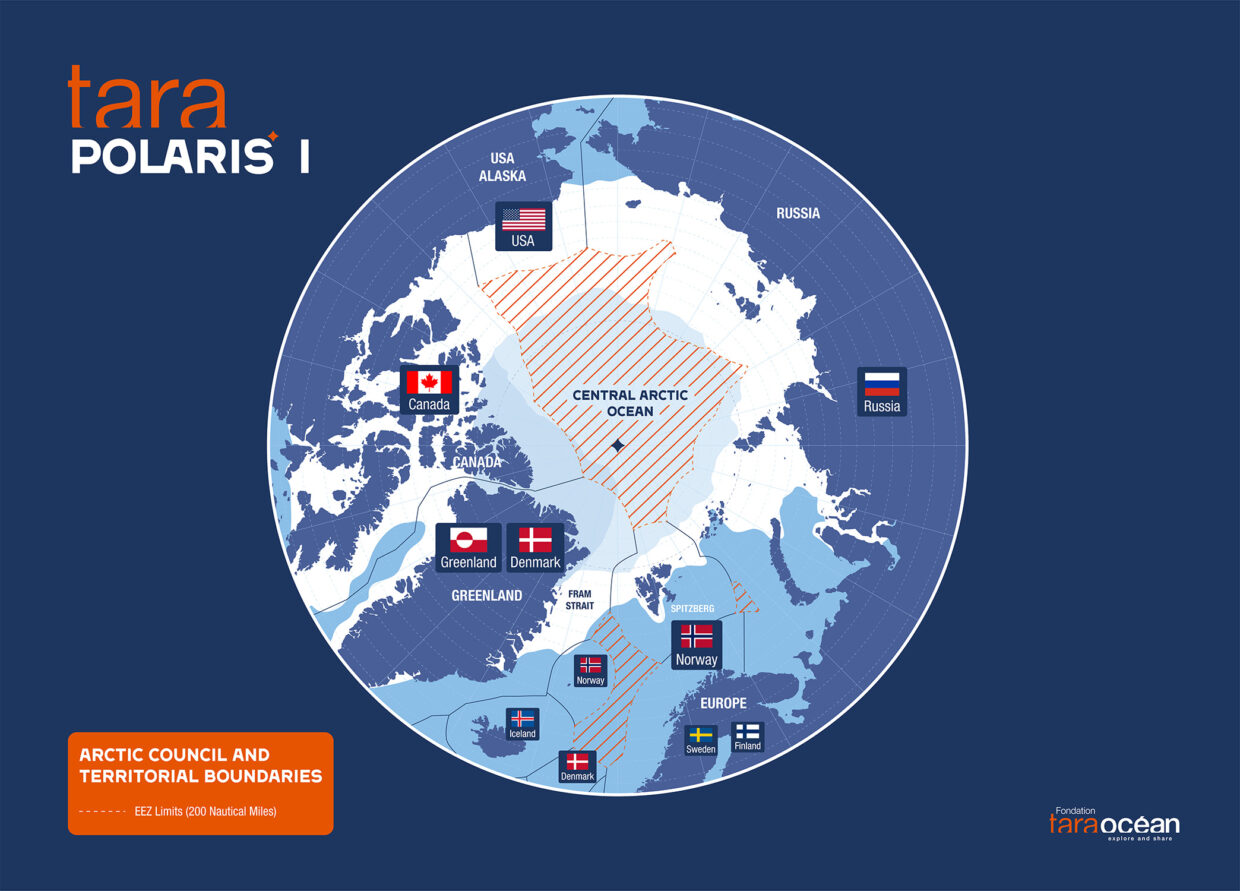
The Arctic Ocean, the planet’s only polar ocean, covers 14 million km², an area equivalent to five times that of the Mediterranean Sea. A large portion of its surface freezes every winter, before the ice cover gradually melts during the summer.
A rapidly changing environment
In addition to Arctic amplification, another phenomenon has been observed over the past fifteen years: Arctic Atlanticization. The increased inflow of warmer, saltier Atlantic waters is disrupting the natural stratification of the Central Arctic Ocean.
These changes are having significant impacts on ecosystems, ranging from organisms at the base of the food chain, such as plankton and fish, to the region’s iconic marine mammals.
This transition to a new state of the Arctic makes systematic, year-round, and long-term monitoring essential. The knowledge gained should help improve climate models and inform policy decisions regarding a region subject to multiple environmental, economic, and geopolitical pressures.
Arctic sea ice: a living ecosystem undergoing rapid change
Sea ice is not just a vast expanse of ice.
It can be considered one of Earth’s major biomes. Whether it is a few hours old or several years old, whether it is in the form of slush or hard ice, it always supports life.
Its porous structure provides micro-spaces containing the elements necessary for life, drawn from both the atmosphere and the Ocean.
Sea ice thus serves as a refuge for a wide variety of organisms—including viruses, archaea, bacteria, protists, small invertebrates, and even fish larvae—despite particularly extreme conditions in terms of temperature, salinity, and pH.
However, as sea ice thins and gradually disappears, the living conditions for these organisms are being disrupted. Current trends indicate that species that depend on sea ice for reproduction, rest, or feeding will see their ranges shrink as sea ice retreats earlier and the open-water season lengthens.
Understanding these mechanisms is therefore one of the major challenges facing scientific research in the Arctic.
Why is it so difficult to study the Central Arctic Ocean?
The Central Arctic Ocean remains a region that is difficult to access and still insufficiently observed, particularly during certain times of the year.
Seasonality, however, is a fundamental aspect of its functioning. Light, temperature, sea ice, and Ocean dynamics vary significantly over the course of the months.
This icy region can experience up to 6 months of polar night and 6 months of daylight, with constant daylight in the summer (no sunrise or sunset).
One of the key scientific challenges is to understand how organisms living in the heart of this Ocean cope with this extreme seasonality and how they survive during the long polar night.
We absolutely need observations to better understand the nature of the changes taking place in the Arctic, particularly to capture the entire annual cycle and track year-to-year variability.
Marcel Babin, CNRS polar oceanographer at the Takuvik Laboratory (CNRS/Laval University/Sorbonne), Scientific Director of Tara Polaris I
Tara Polaris: 10 Scientific Expeditions to the Heart of the Arctic
Tara Polaris I (2026–2027) is the first expedition in a 20-year scientific programTara Polaris (I, II, …, X), developed by a consortium of more than 35 laboratories from 12 different countries: France (15 laboratories), Canada, Germany, Norway, Switzerland, Finland, Denmark, Spain, Belgium, the United States, Israel, and Japan.
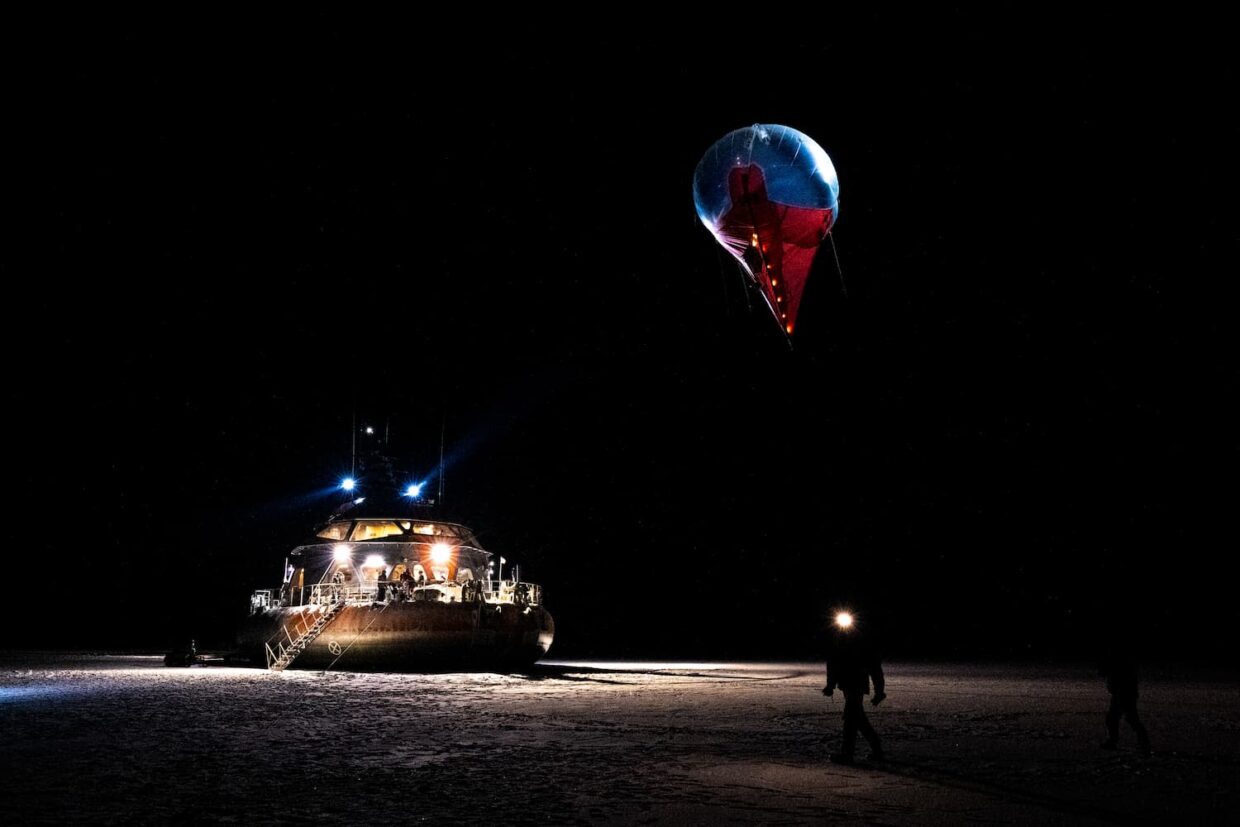
Tara Polar Station drifting research station will be deployed in the Central Arctic Ocean for 10 consecutive expeditions through 2046. A true laboratory-observatory, it hosts specialists from various disciplines: biologists, physicists, ecologists, glaciologists, atmospheric scientists, and oceanographers.
This multidisciplinary approach is essential: the goal is not to observe the Ocean, the ice, or the atmosphere separately, but to better understand their interactions and interconnectivity.
Tara Polaris I will thus enable an initial assessment of the health of the Central Arctic Ocean.
Tara Polaris I: Key Figures
2026–2027: the program’s first expedition;
10 expeditions planned through 2046;
approximately 9 months of overwintering for the first twelve crew members;
observations ranging from the atmosphere to the depths of the Central Arctic Ocean ;
What are the scientific objectives of Tara Polaris I?
The Tara Polaris I expedition aims to gain a better understanding of how the Central Arctic Ocean functions and the changes affecting it.
Several key questions will guide the research.
Exploring a biodiversity that remains largely unknown
One of the program’s objectives is to expand our understanding of biodiversity by exploring hard-to-reach regions.
In particular, scientists will seek to understand the adaptations that allow life to persist in this extreme environment. They may also identify new molecules, species, or biological processes.
Understanding the Consequences of Sea Ice Melting
The decline in sea ice is profoundly altering the physical, chemical, and biological conditions of the Central Arctic Ocean.
Research should help analyze the consequences of this melting on the fragile ecosystems that depend directly or indirectly on sea ice.
Measuring the Impact of Pollution
Scientists will also study contaminants in the Arctic environment. In particular, the station is intended to help document pollution in the atmosphere, snow, ice, and the Ocean, in order to better understand its origin, circulation, and impact on ecosystems.
Monitor fish stocks and the arrival of new species
The Tara Polaris I expedition will also help monitor Arctic fish stocks and the effects of the arrival of species from more temperate regions. Climate change and the “Atlanticization” of the Arctic may, in fact, gradually alter the composition of ecosystems.
How will scientists study the sea ice-Ocean-atmosphere continuum?
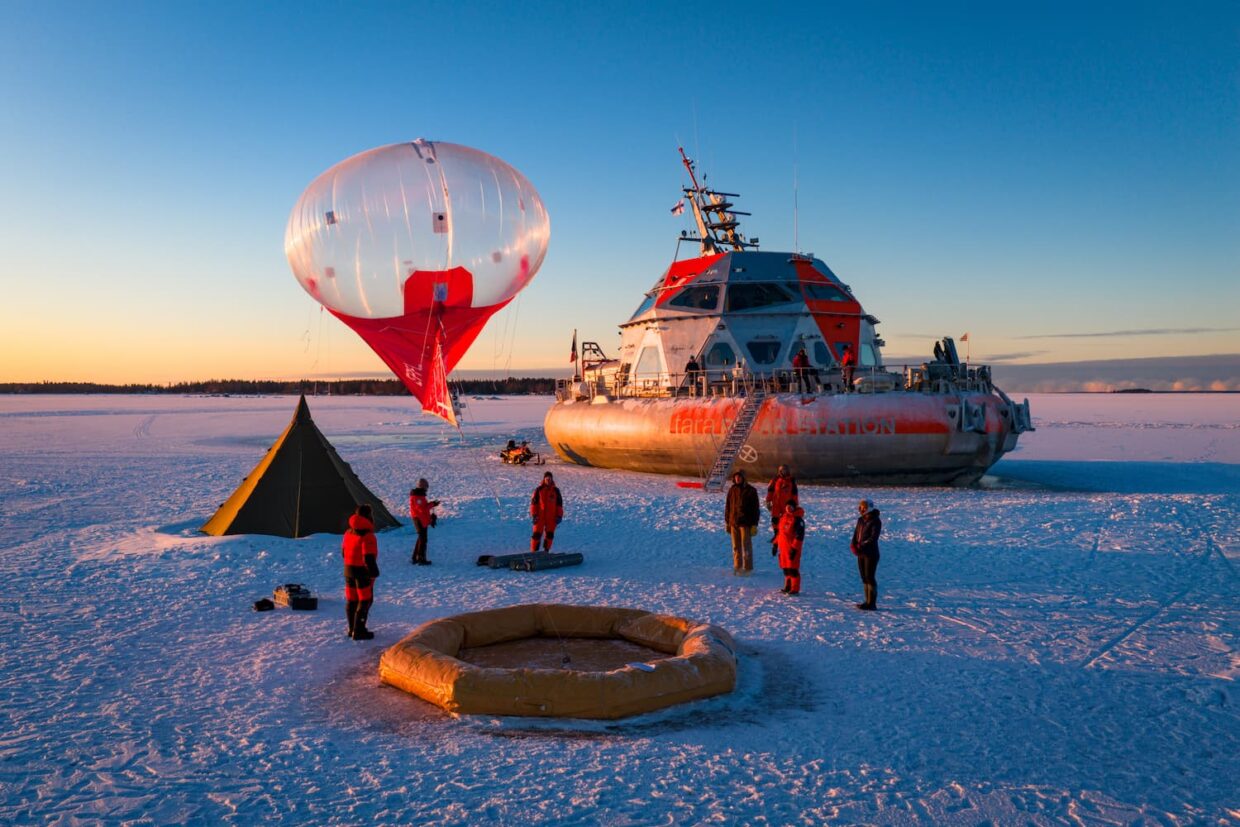
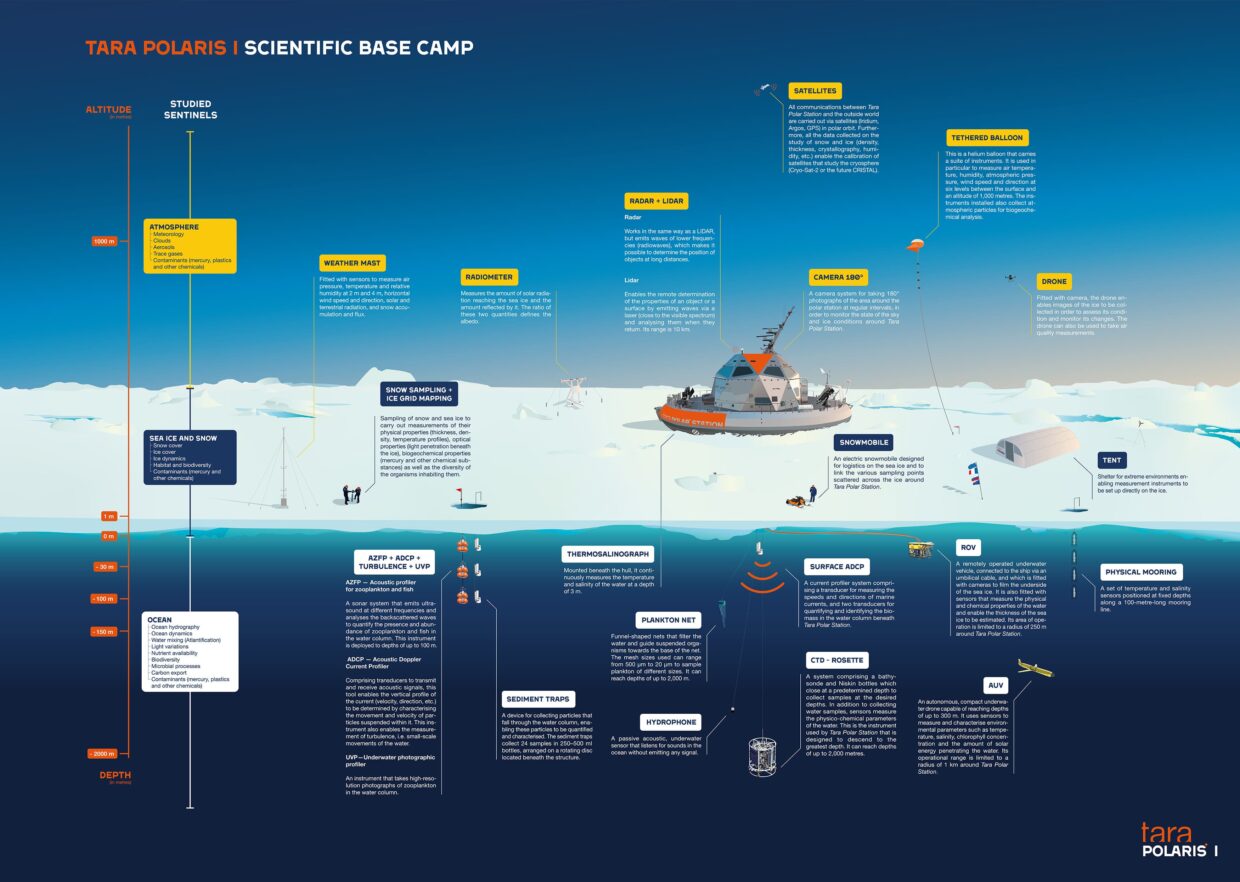
Tara Polar Station was designed as a true drifting scientific base camp. The expedition aims to characterize the various components of the Central Arctic Ocean ; the Ocean, sea ice, snow, and atmosphere ; as well as their interactions. To this end, numerous instruments will be deployed on, under, and around the sea ice.
A tethered balloon equipped with various instruments can take measurements at altitudes of up to 1,000 meters.
Studying Snow and Sea Ice
Snow samples and ice cores are used to study their physical and chemical properties: thickness, density, temperature, optical properties, and the presence of pollutants. Scientists are also interested in the organisms that live directly within the ice.
Exploring the Ocean Beneath the Ice
Beneath the sea ice, the teams will be able to observe the water column using a variety of instruments. For example, acoustic instruments will be used to quantify the presence and abundance of zooplankton and fish, while current meters will measure the speed and direction of currents. Plankton nets, hydrophones, sediment traps, sensors, and autonomous underwater vehicles round out this scientific array.
Why study the Ocean, ice, and the atmosphere all at the same time?
The functioning of the Arctic depends on the constant interactions between several compartments. The Ocean influences the ice. The ice alters exchanges with the atmosphere. Available light determines photosynthesis and, therefore, part of marine life. Currents transport heat, nutrients, organisms, and contaminants. This is why Tara Polaris I aims to study the interconnectivity among these different components. Seasonality is also a key aspect of how this system and the Arctic marine ecosystem function, a factor that has not always been fully accounted for in previous scientific expeditions.
What will we learn from the data collected during Tara Polaris I?
In the long term, the Tara Polaris expeditions are expected to generate new data that will help refine climate change models and, eventually, lead to a better understanding of certain meteorological trends at lower latitudes—particularly in Europe by 2050. These observations will also make it possible to study the impact of global changes (climate and pollution) on the planet’s functioning. The scientific results will be available as open access and may help improve governance policies for the Central Arctic Ocean. By repeating these observations over the course of ten successive expeditions, the program will also be able to track changes in this exceptional environment over the long term. Tara Polaris will thus bear witness to the transformations of the Arctic through 2046.
The Arctic is one of the regions where the effects of climate change are most rapid. Changes there influence ecosystems, the exchange between the Ocean and the atmosphere, and, more broadly, the functioning of the global climate. Studying the Arctic therefore helps us better understand the changes underway and improve climate models.
What is Tara Polaris I?
Tara Polaris I is the first scientific expedition of the Tara Polaris program (2026–2046). Its goal is to conduct an initial assessment of the impact of global change in the Arctic and to study the ecosystems of the Central Arctic Ocean.
What is the Tara Polar Station?
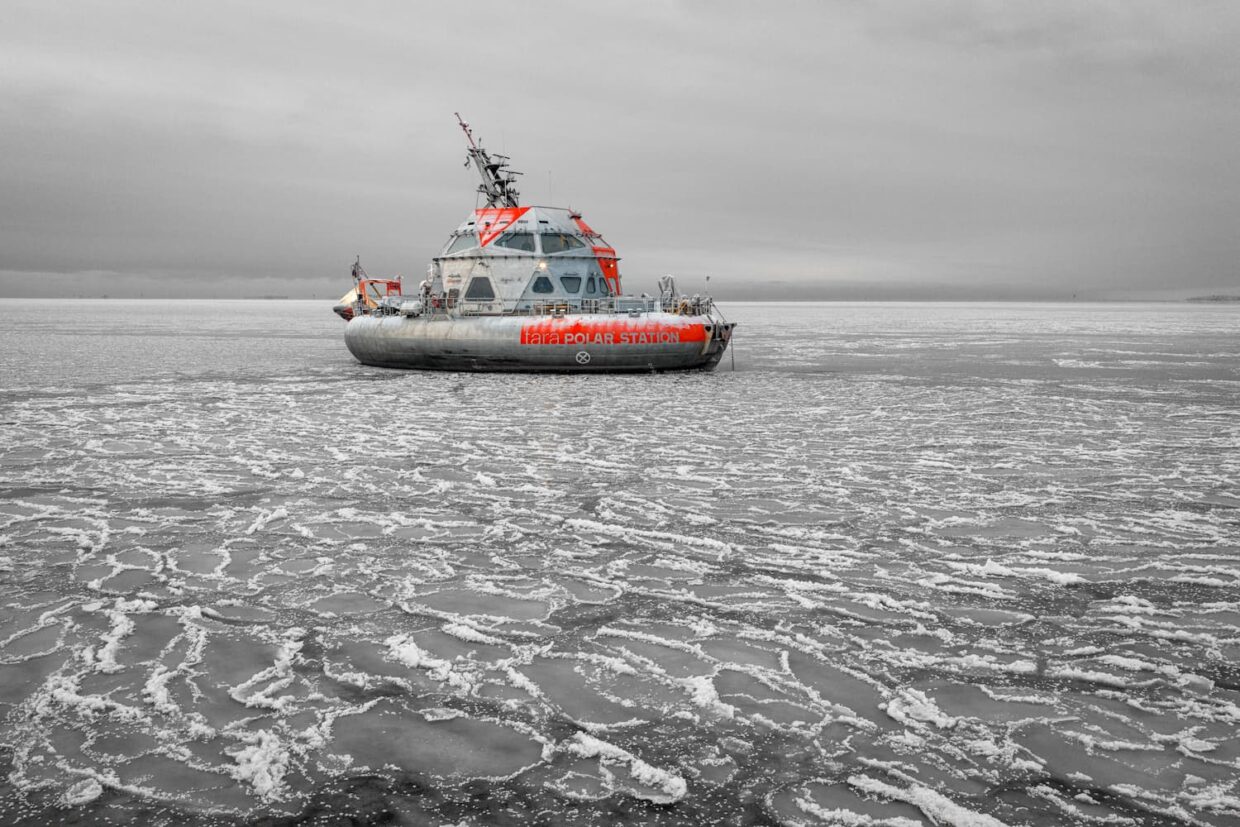
Tara Polar Station is a drifting polar station designed asa laboratory and observatory. It is intended to enable scientific teams to simultaneously study the Ocean, sea ice, snow, the atmosphere, and biodiversity in the heart of the central Arctic Ocean.
How many expeditions are planned as part of the Tara Polaris program?
The program calls for 10 consecutive expeditions to the central Arctic Ocean through 2046. These expeditions will help document the long-term changes in this region.