Jobs at a shipyard: an inside look at the Tara Polar Station shipyard
Back to the heart of the Tara Polar Station construction site. Designed to drift with the pack ice and withstand extreme conditions, this research vessel is pushing the boundaries of marine engineering. But behind this technical challenge are, above all, the men and women who have worked behind the scenes: welders, engineers, naval architects, logisticians… Discover some of these extraordinary professions.
An exceptional shipyard: Tara Polar Station
A research vessel for exploring the Arctic
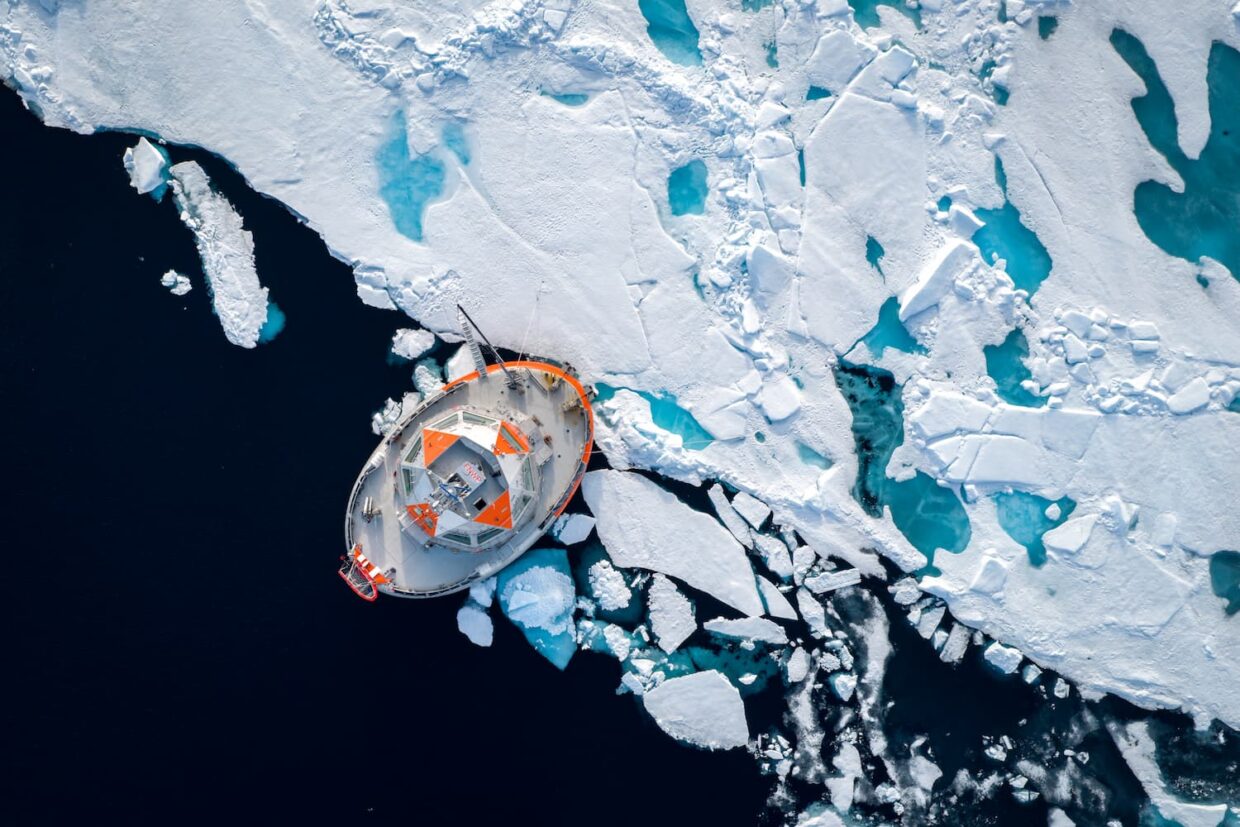
Tara Polar Station is a drifting research station designed to explore the Central Arctic Ocean and study its evolution in the context of climate change. More than just a ship, it is an observatory and a laboratory capable of becoming trapped in sea ice and drifting with it for long periods.
The aim of this station is to enable scientists to directly observe the polar environment in all its complexity: the sea ice, the ocean, the atmosphere and marine biodiversity. On board, researchers from various disciplines will work together to collect data essential to understanding the rapid transformations of the Arctic ecosystem and its biodiversity, which remains largely unknown. The Tara Polaris research programme will be carried out across the seasons and over the long term in order to track the evolution of polar ecosystems over several decades.
A project entrusted to Constructions Mécaniques de Normandie in Cherbourg
The construction of Tara Polar Station has been entrusted to Constructions Mécaniques de Normandie (CMN), based in Cherbourg. The project, which began in September 2023, has drawn on industrial and maritime expertise of the highest calibre.
This is a particularly innovative shipbuilding project, as the Tara Polar Station is not a conventional vessel. The design plans were drawn up by the Mauric Design Office and architect Olivier Petit, with the primary constraint being the ability to operate in extreme polar conditions. Its specific shape enables it to withstand ice pressure and drift in a controlled manner with the pack ice.
The hull, made of thick aluminium (2 cm), has been designed to withstand the impacts and mechanical stresses associated with icy environments. Every component of the vessel has been engineered to ensure optimal resistance to extremely low temperatures and the challenging navigation conditions of the Arctic.
An extraordinary technical and human challenge
The construction of Tara Polar Station represented an exceptional challenge, both technical and human. The vessel must be capable of operating in extreme conditions, with temperatures reaching around -52°C and constant exposure to ice and polar drift.
This requirement demands a very high level of precision at every stage of construction. Welding operations, the assembly of the thick aluminium hull and the integration of on-board technologies call for absolute rigour. Every component must fit perfectly to ensure the vessel’s strength and safety in a particularly hostile environment.
Beyond the technical aspects, this project also required close coordination between numerous shipbuilding trades. Engineers, technicians and skilled workers worked together to meet a rare industrial challenge: building a vessel capable of conducting scientific research in the heart of the Arctic.
The different trades present on a shipyard
A shipyard is a veritable ecosystem where a wide variety of roles intersect, each playing an essential part in the creation of a ship.
From the initial design to the final welds, these trades combine technical expertise, teamwork and a passion for the maritime world. Through the Tara Polar Station project, discover some of these key professions.
Naval Architect
Olivier Petit was the architect of the schooner Tara in 1989, alongside Luc Bouvet. He was also chosen as one of the naval architects for the Tara Polar Station, working alongside the Mauric Design Office, 12 years ago. A trained architect, he designs the ship’s lines, volumes and overall balance.
“What I love is designing boats and being on the water. A boat has many lives: every expedition brings a new crew, a new story. When you see everything the schooner has accumulated over 35 years, it’s incredible, because we’re carrying people and experiences.” Olivier Petit
For Tara Polar Station, the architects had to integrate technical, environmental and scientific constraints into a single project. This meant designing a ship capable of withstanding becoming trapped in ice, drifting on the pack ice, extreme temperatures and specific sailing conditions.
This profession requires the ability to synthesise information and great perseverance. Projects stretch over years, with periods of standstill, re-evaluation, resumption and constant adaptation.
But it is also a deeply emotional profession: seeing a boat come to life, moving from plan to reality, remains a defining moment. Like when the station’s structure was assembled for the first time, revealing all its geometric complexity.
“What struck me most during the construction was when the geodesic dome was finished, still bare, with no holes drilled in it. It looked like a sort of kaleidoscope. We were in a huge nave in Cherbourg, a magnificent place, almost like a cathedral. They lifted it gently to place it on the deck, and it began to rotate slightly. The sunlight streamed in horizontally, and all the facets began to sparkle. It was a magical moment: the boat was coming to life.” Olivier Petit
Technical Director of Shipbuilding
Loïc Vallette played a central role in organising the shipyard. Acting as a link between design and construction, he coordinated the various parties involved in the project.
“I oversee this project on a day-to-day basis and work with the shipyard, the design office and the suppliers. We are responsible for drawing up the detailed plans for the vessel so that they are as well-suited as possible to its future operating environment.” as Loïc Vallette remarked at the start of construction.
This role relies on interpersonal skills as much as technical ones: listening, mediating, finding compromises. On such an unusual project, where constraints are numerous (polar environment, scientific requirements, space limitations), coordination becomes a real challenge.
It is also very hands-on work: seeing a ship gradually take shape, piece by piece, gives a tangible dimension to years of planning.
“This project is particularly close to my heart for several reasons. Firstly, it is led by the Tara Ocean Foundation, which I know well having worked there before. The projects it undertakes are always inspiring. Secondly, it is a truly unique project. The boat is subject to numerous constraints, which makes the challenge particularly interesting to tackle.” Loïc Vallette
Welder
Finally, it’s impossible to talk about a shipyard without mentioning the manual trades, such as that of Arnaud Bissière, a welder.
It was he, together with his colleagues at Constructions Mécaniques de Normandie, who turned the plans into reality. Starting with sheets of metal, they gradually assembled the boat’s structure, adhering to the strictest standards of precision.
“For me, it’s truly a labour of passion. Welding is something I really enjoy. On this project, we started almost from scratch. Across all trades, it required significant skills: precision, dexterity, and also the ability to read technical documents, plans and the client’s specifications.” Arnaud Bissière
Shipbuilding welding requires a high level of technical expertise. Certain processes, such as TIG (Tungsten Inert Gas), demand a high degree of precision. For the Tara Polar Station, the challenge facing the teams working on the project was even greater: the hull’s unusual, highly rounded shape deviates from the usual standards. Every movement therefore had to be executed with perfect precision.
“What’s motivating is working on something that’s never been done before. We’re used to building large military vessels, but here, just by looking at the plans, you can see that this is a truly different and interesting project.” Arnaud Bissière
Oceanographic engineer: integrating science on board
For Thomas Linkowski, the challenge was a different one: the aim was to transform the ship into a fully-fledged floating laboratory and observatory.
His role consists of gathering the scientists’ requirements and translating them into concrete installations: measuring instruments, workspaces, data collection systems. This involves constant collaboration with the shipyard teams, researchers and seafarers.
This profession is characterised by great versatility. Electronics, mechanics, IT: the oceanographic engineer has a hand in everything. He must also demonstrate adaptability and resourcefulness, particularly when on expedition, far from any support.
On Tara Polar Station, the main constraint is space. We must manage to integrate equipment comparable to that found in large scientific laboratories,
At Tara Polar Station, the main constraint is space. We need to fit equipment comparable to that found in large scientific laboratories into a much smaller space. Every decision therefore involves striking a balance between performance, space requirements and technical feasibility.
“What makes this project unique is precisely the amount of space available. There is more space than on the schooner Tara, but we are working with a consortium of researchers who are used to very large research vessels, particularly icebreakers. The challenge, therefore, is to fit in as much scientific equipment as on these large platforms, but within a much more confined space. We are constantly striking a balance between Tara’s small spaces and the large spaces of research vessels.” Thomas Linkowski
Découvrez les métiers du chantier en vidéo sur notre chaine youtube